by John A. “Skip” Laitner and Stephen Menke
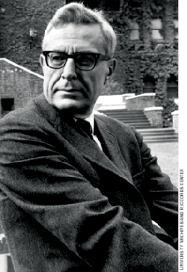
It was anthropologist, educator, and natural science writer , Dr. Loren Eiseley, who first suggested that it was not the stirrup, or the bow and arrow, or the microchip. Not even the steam engine. But it was flowers that changed the world. Loren Eiseley was right. It was flowers that transformed the earth and made it ours. In a remarkable essay, “How Flowers Changed the World” (found
as a chapter in an equally perceptive 1957 book, The Immense Journey), Eiseley reminded us, as hard as it may to imagine today, “once upon a time there were no flowers at all.”
As a Nebraska native son, Eiseley spent his early years absorbing the biodiversity of the Salt Creek watershed near his Lincoln, Nebraska birthplace. These early observations of the interrelationships of nature and his place in it were a foundation for his writings and teachings. Like many Nebraskans, with interconnected prairie ecosystems and small human groupings in his humble childhood, he had a wholistic view that grounded him for success in the larger world.
With his anthropologist’s wholistic view of our place in the natural world, Eiseley examined the philosophy of humanity’s role in science and nature. He provided a narrative that linked nineteenth century authors, like Sir Patrick Geddes and Charles Darwin, with early and mid-twentieth century authors, like John Muir, Aldo Leopold, Lewis Mumford, Isaac Asimov, and Carl Sagan.
It was the rise of the flowering plants, he wrote, that provided the energy which changed the nature of the living world . One might suggest that without the gift of flowers and the infinite diversity of their fruits, had we continued to exist at all, we would be unrecognizable today. The Archaeopteryx, or lizard-bird, might still be snapping at beetles on a sequoia limb; and we might still be “the genie in the bottle, encased in the body of a creature about the size of a rat.”
Yes, as Eiseley wrote in 1957, “the weight of a petal has changed the face of the world and made it ours.” And even if we’re mostly unaware of the larger world and the changing climate around us, we might today, in our own best interest, ask the question: Will the way we use engines, and the semiconductor chip, somehow overcome the vitality of flowers? It never hurts to ask such questions. Our answers may provide for the well-being of both the flowers and the human spirit.
It is relevant today as ever to read his works, which you can check out at https://www.eiseley.org/bibliography.php. And learn more about his life and career at https://en.wikipedia.org/wiki/Loren_Eiseley.