Categories
Meeting

From Shale to Plastic

October Sustainability Spotlight, Tuesday, Oct 13, 2026
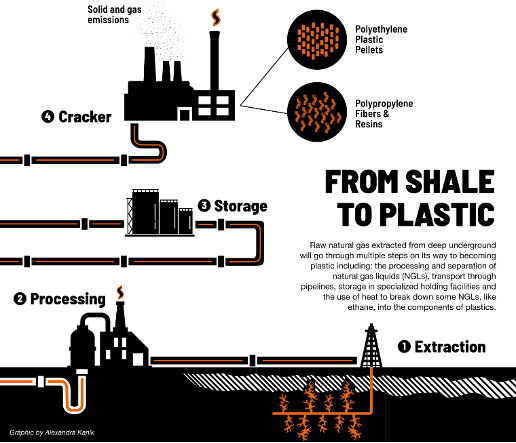
(Source:  Alexandra Kanik | Ohio Valley ReSource)

https://us02web.zoom.us/j/89287884335?pwd=a66n9DRguEpnYlCnxAN9ssYqbhPqov.1

Plastic, especially in single-use items, is often seen mainly as a waste and litter issue.  But many of its environmental and public health impacts start earlier in the plastic lifecycle, during fossil fuel extraction, refining and polymer manufacturing.

Join us at our October Sustainability Spotlight as we explore the often-overlooked upstream impacts of plastic.  We’ll trace the journey from extracting natural gas from shale formations to processing fossil-fuel-derived chemicals into plastic feedstocks and manufacturing everyday products such as plastic straws.

We’ll also examine how the infrastructure that supports plastic production can negatively affect communities near natural gas extraction sites and petrochemical facilities.  The key takeaway is clear:  reducing plastic pollution means doing much more than managing waste after it is created. It also requires recognizing plastic’s strong ties to the fossil fuel economy and the burdens that production places on nearby communities through air, water, and soil.

Categories
Heroes

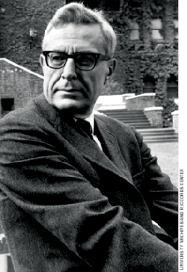
Dr. Loren Eiseley, How Flowers Changed the World

by John A. “Skip” Laitner and Stephen Menke

It was anthropologist, educator, and natural science writer , Dr. Loren Eiseley, who first suggested that it was not the stirrup, or the bow and arrow, or the microchip. Not even the steam engine. But it was flowers that changed the world. Loren Eiseley was right. It was flowers that transformed the earth and made it ours. In a remarkable essay, “How Flowers Changed the World” (found

as a chapter in an equally perceptive  1957 book, The Immense Journey), Eiseley reminded us, as hard as it may to imagine today, “once upon a time there were no flowers at all.”
 
As a Nebraska native son, Eiseley spent his early years absorbing the biodiversity of the Salt Creek watershed near his Lincoln, Nebraska birthplace. These early observations of the interrelationships of nature and his place in it were a foundation for his writings and teachings. Like many Nebraskans, with interconnected prairie ecosystems and small human groupings in his humble childhood, he had a wholistic view that grounded him for success in the larger world.

With his anthropologist’s wholistic  view of our place in the natural world, Eiseley examined the philosophy of humanity’s role in science and nature. He provided a narrative that linked nineteenth century authors, like Sir Patrick Geddes and Charles Darwin, with early and mid-twentieth century authors, like John Muir, Aldo Leopold, Lewis Mumford, Isaac Asimov, and Carl Sagan.
 
It was the rise of the flowering plants, he wrote, that provided the energy which changed the nature of the living world . One might suggest that without the gift of flowers and the infinite diversity of their fruits, had we continued to exist at all, we would be unrecognizable today. The Archaeopteryx, or lizard-bird, might still be snapping at beetles on a sequoia limb; and we might still be “the genie in the bottle, encased in the body of a creature about the size of a rat.”
 
Yes, as Eiseley wrote in 1957, “the weight of a petal has changed the face of the world and made it ours.” And even if we’re mostly unaware of the larger world and the changing climate around us, we might today, in our own best interest, ask the question: Will the way we use engines, and the semiconductor chip, somehow overcome the vitality of flowers? It never hurts to ask such questions.  Our answers may provide for the well-being of both the flowers and the human spirit.
 
It is relevant today as ever to read his works, which you can check out at https://www.eiseley.org/bibliography.php. And learn more about his life and career at https://en.wikipedia.org/wiki/Loren_Eiseley.

Categories
Event

 Renewable Energy for Tucson’s Future

SUSTAINABILITY SPOTLIGHT

A panel discussion
Tuesday, September 8, 6:00-7:15 pm
https://youtu.be/cUzS-hhOJOMpwd=fHH7wdbbiaiwrtmcthjhwDWbcPJDBv.1

Long-term drought, rising temperatures, air and water pollution, and increasing electric bills. The need to increase our energy productivity and decarbonize our economy has never been more apparent than now, but how do we get started?  This panel discussion will bring together a variety of viewpoints about what we can start doing today in Tucson for a more sustainable energy and economic future, from household and small business retrofitting to the proposed Distributed Capacity Procurement plan for the city.
 
Moderated by Stuart Moody, training coordinator for Sustainable Tucson.  Invited panelists are Michael Catanzaro, City of Tucson’s Energy Manager, and Neil Saunders, Renewable Development Manager for TEP. 
 
Jason Laros, former energy manager for Tucson and now co-principal of Resilience Developers, will serve as discussant.