Categories
Heroes

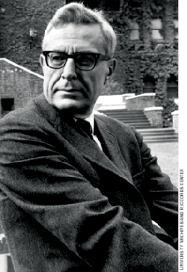
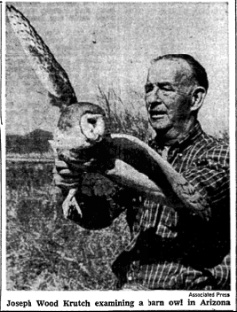
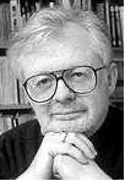
Tucsonan Dr. Joseph Wood Krutch

There are some surprising insights that emerge from being out in the desert, if we’re willing to take the time to really look. A deeper understanding of the desert flora and fauna – one might say a deeper understanding of the biology and the desert ecosystem – might also inform the way we look at the economy and at our social systems. And long-time Tucsonan, Dr. Joseph Wood Krutch, took that time to look. But why the heck would the University of Arizona name a memorial garden after Joseph Wood Krutch? (You did pronounce it as “Krewch” or “Krootch”, didn’t you?)

Joseph Wood Krutch (November 25, 1893 – May 22, 1970) earned a doctorate in English literature from Columbia University in 1923, completing his dissertation, “Comedy and Conscience After the Restoration.” But it was his transition from a Columbia English professor to a celebrated nature writer and conservationist, and his book The Desert Year, that persuaded me to return to Tucson when the University of Arizona invited me to accept a sabbatical in 2011.

Although he was a prolific literary and drama critic, Krutch also became equally well known in later life as a conservationist. Upon retiring from Columbia University in 1952, Krutch relocated to Tucson. Although never hired as faculty there, he remained a prominent literary and naturalist figure associated with the university, later becoming a founding board member of the Arizona-Sonora Desert Museum. The University of Arizona dedicated the Joseph Wood Krutch Garden to his memory in 198

As noted in the New York Times story of his passing in 1970, Krutch had written, “Man’s humanity is threatened by the almost exclusively technological approach in social, political and philosophical thought.” In his books, including The Voice of the Desert (1955) and his 1954 volume, The Measure of Man, which won the National Book Award for Nonfiction, Krutch expressed a longing for an older, more contemplative way of life and a distaste for many of the inventions of the 20th century. He commented, “If you drive a car at 70 miles an hour, you can’t reflect or think about anything, you can’t do anything but keep the monster under control.” Pondering this notion, we might join him in asking, is this “the metaphor of our society as a whole?” 

In the spirit of a more contemplative way of life, we might honor Krutch by visiting the University’s Memorial Garden, and thinking through ways to shift the economic growth monster to support more fully Tucson and Pima County’s social, environmental, and community well-being. Krutch famously called the desert a place where a smaller number of species, facing harsher restrictions, manage to live without the overcrowding and aggressive competition seen in the tropics. Still a lesson to be learned?

Categories
Event

Electrification: Everything You Wanted to Know, But Didn’t Know Who to Ask

July 21 @ 6:00

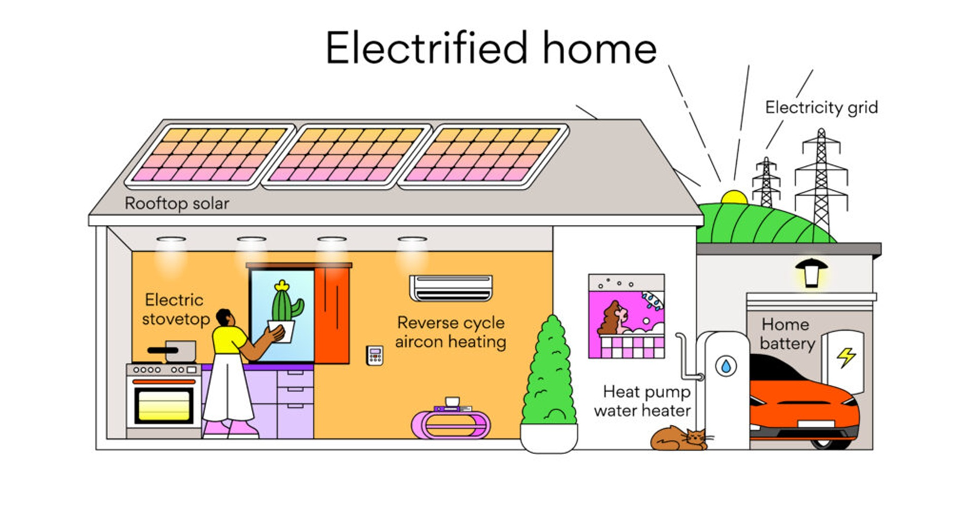
Join us for the July Sustainability Spotlight on Electrification. Our speaker, Gordon Nuttall, a coach with GoElectricAZ, will share an overview of the opportunities for electrifying our homes and the benefits of doing so. He will explore the following issues:

  • Learn how you can make your home more energy efficient!
  • Find practical ways to save energy without spending much.
  • Explore installing a heat pump for efficient heating and cooling, or one for efficient water heating.
  • Learn about backup battery systems in case the power goes out.
  • Learn about technologies and available programs to help with costs.

There will be ample time for Q&A, and you can leave with an action plan

Categories
Heroes

Dr. Robert U. Ayres

Our June 2026 Hero of Sustainability

Dr. Robert U. Ayres

By John A. “Skip” Laitner

This acknowledgement of Bob Ayres is based on a book chapter I was invited to write by his colleagues at INSEAD (Institut EuropĂŠen d’Administration des Affaires), one of the world’s most prestigious and largest graduate business schools with its main campus in Fontainebleau, France.  The complete book should be published next year.  Its working title is: “The fundamental works of Robert Ayres: Pioneer of industrial ecology and early prophet of the fundamental role of energy and materials in our economic system.” By World Scientific Press.

There are so many instances when humanity has thought one way about some aspect of the world, and then found another way of thinking about it.  Centuries ago, we thought the Earth was at the center of the universe.  But then we learned that the Earth orbits the Sun, and the Sun itself is only one small object within a very large universe (Gleiser 2024).

We used to think that DNA is the driving force in the development of life.  Now, however, as Philip Ball noted in Scientific American, it is RNA, not DNA, that is the key to life (Ball 2025).

And consider the comment from New York Times science writer Eugene Linden: “For decades, most scientists saw climate change as a distant prospect. We now know that thinking was wrong” (Linden 2019).  Indeed, we now know that climate change poses very real and immediate social and economic burdens.  

What else might we be overlooking or misunderstanding in the ways that we think about energy, materials, and the environment? 

One big, overlooked aspect might be the work of Dr. Robert U. (“Bob”) Ayres, a mathematical physicist and ecological economist.  Bob was a pioneer of industrial ecology and early prophet of the fundamental role of energy and materials in our economic system.

Born in June 1939, Bob was a long-time colleague and collaborator who, alas, passed away in October 2023.  But building on his long-time research we might better understand and act on his critical ideas of industrial metabolism – or what we might call “social metabolism” – important steps to realize the sustainability transition.

Bob was an Emeritus Professor at INSEAD (Institut EuropĂŠen d’Administration des Affaires), where he held the Novartis Chair in Management and the Environment.  Applying thermodynamic principles to economic issues, he was a prominent figure in industrial ecology, ecological economics, and technology forecasting.  His work was part of the inspiration for starting the Yale Journal of Industrial Ecology

Bob’s long-time research underscores the need for a healthier and more productive use of both energy and resources as they now impact our immediate social, environmental, and economic well-being.  His most critical book, co-authored with Dr. Benjamin Warr in 2009, was The Economic Growth Engine: How Energy and Work Drive Material Prosperity, https://www.e-elgar.com/shop/usd/the-economic-growth-engine-9781849804356.html.  As we come together to rethink the inter-relationships of energy, water, labor, investment, and community well-being, we would do well to mine his funds of insight.

For more background on Bob’s research and career, see this well-written Wikipedia entry at:  https://en.wikipedia.org/wiki/Robert_Ayres_(scientist).  

Categories
Event

Early Arizona Politics and the Central Arizona Project

Tuesday, June 9
6:00-7:15 pm

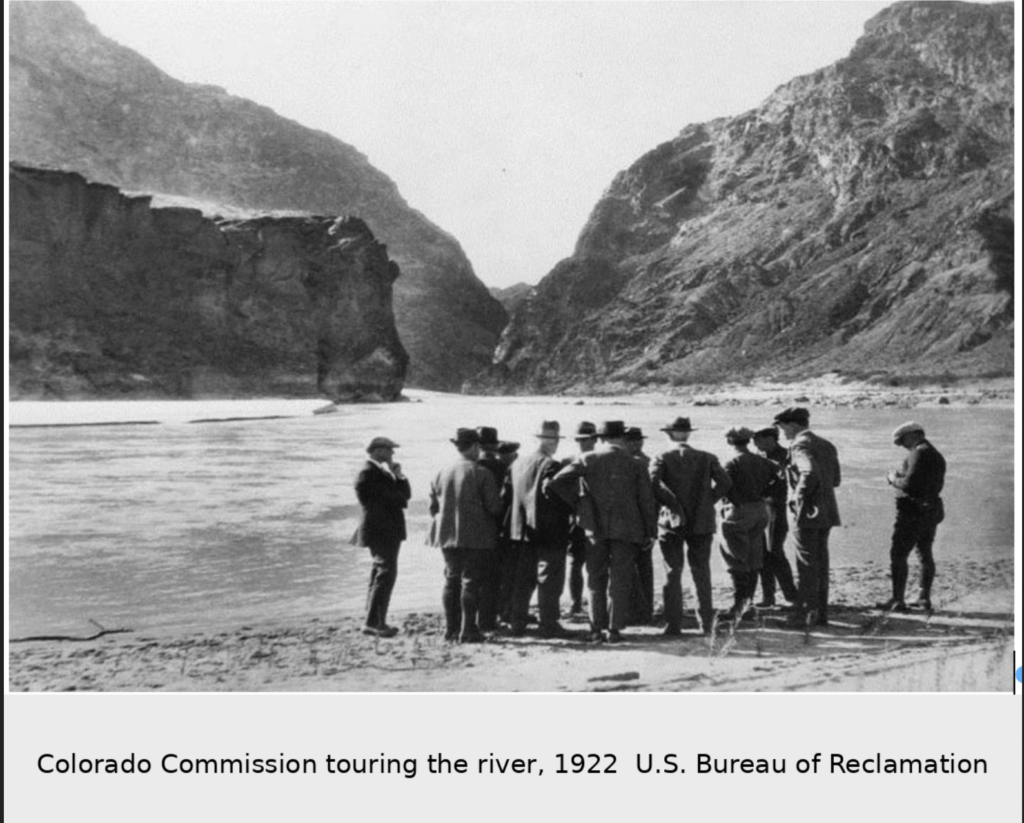
Decisions made long ago structure the contemporary debates among the Colorado Basin states today.  This presentation explores early politics internal to Arizona to explain some of our current situation. Despite benefiting from early federal investments in dam building and “reclamation,” between 1923 and 1944, business interests in the state of Arizona opposed approval of the 1922 Colorado Compact governing use of the Colorado River and saw California as their enemy.

Concerns about the adequacy of flows began even before the Compact, but became a most unwelcome discussion in the 1940s when the state’s leaders acquiesced to the federal government’s terms in order to fund plans for the Central Arizona Project.  

Knowing early history helps explain why our state took so long to receive and utilize its full share of Colorado River water, and why users of the Central Arizona Project are so vulnerable to shortages on the river.  This presentation will conclude with some information about Arizona’s recent strategies for dealing with shortages.

SPEAKER

Julia Fonseca is a hydrologist, now consulting as Madrean Resources. While at Pima County Regional Flood Control District, she was the project manager for various recharge feasibility studies in the Tucson area, which culminated in the Lower Santa Cruz Replenishment

Project for CAP recharge and the Marana High Plains effluent recharge project. Later, she helped to develop County programs for riparian protection and restoration, and compliance with the Clean Water Act and Endangered Species Act.  She is currently writing a book about George Edson Philip Smith, Tucson’s first home-grown hydrologist.

Categories
Meeting

Free Speech, Right Speech, and the Protection of Our Planet

Tuesday, May 12, 6:00 pm

It would be hard to identify an issue more pressing than the preservation of our precious planet. To complicate things, there is a gnawing sense that we are running out of time and the task is now impossible. The First Amendment gives us wide berth to advocate for the survival of life on Earth. But is anger-fueled or sensational speech skillful and effective? What do our spiritual traditions, including Buddhism, have to say about “right speech”? And how might its tenets be employed to help us protect the planet — and keep our sanity? This talk by David Bodney aims to shed some light on these issues.

Our Speaker:
David J. Bodney serves as Senior Counsel at Ballard Spahr LLP, where he practices media and constitutional law, and teaches media law as a Professor of Practice at the College of Law

at UA. A graduate of Yale College (B.A., ’76) and the University of Virginia (J.D./M.A., Foreign Affairs, ’79), he served as a legislative aide to Sen. John V. Tunney (D – CA) and began his legal practice at Brown & Bain (now Perkins Coie) in Phoenix.

He served as editor and general counsel to New Times (1990-92), spent 22 years developing an international media law practice at Steptoe & Johnson LLP, and founded the Media and Entertainment Law Group at Ballard Spahr in 2014. David was drawn to Arizona in substantial part to practice Indian law, and he has represented one tribe on a wide array of issues, including natural resources and water law, for over 30 years, a relationship that began through his partnership at Steptoe with Bruce Babbitt. His professional bio can be found at www.ballardspahr.com. In 2020, David moved to Tucson, where he continues to practice and teach—a move that has allowed him to deepen his 50-year practice of Zen Buddhism through Upaya Tucson, an affiliate of the Upaya Zen Center of Santa Fe, New Mexico.

Categories
Event

Sustainable, Affordable Building: Ancient & Modern Designs for Living in the Sonoran Desert

Tuesday, April 14, 2026, 6:00-7:10 pm

Many of the solutions for climate and habitat resilience are hiding in plain sight.  Come to this month’s Sustainability Spotlight to learn about building design principles that help urban and rural communities to weather extreme temperatures and dryness more effectively and, ultimately, at lower cost than “building as usual.”

Our speaker, Bob Vint, has a decades-long career in architecture and is an active teacher in the classroom and in the field (vintarchitects.net). His latest field project involved an ‘Alternative Spring Break’ with his U of A architecture students to Agua Prieta, Sonora, where they helped to build a home for a local family, in partnership with the Rancho Feliz Charitable Organization (ranchofeliz.com). Working alongside local builders and community members, students completed the rough framing for a ‘Highly-Johansen House,’ an economical, insulated shelter named in honor of two key Rancho Feliz volunteers & supporters. Students and faculty volunteers stayed at ‘La Hacienda Feliz’ volunteer dormitory, for which Vint donated the design in 2020-2021. This community-engaged learning model connects design education with real-world impact and is a model that may have real-world applications in a variety of endeavors.

BOB VINT is a native Tucsonan who has practiced as a licensed architect in Arizona, New Mexico, Texas, and Massachusetts.  He has served as preservation architect for the Mission San Xavier del Bac in Pima County, the most significant historic building in Arizona, as well as for the pre-historic Native American Cliff Dwellings of the

Sierra Ancha in the Tonto National Forest (dating to 1290, built of stone with mud mortar – a preservation study carried out for the U.S. Forest Service.)  Additional projects of note include Linda Ronstadt’s Tucson residence, the main entrance of the Arizona Sonora Desert Museum, and more recently, the expansion of The Loft Cinema.

Vint is the principal co-author of a book on affordable housing in the Southwest published by the US Department of Housing & Urban Development, Southwest Housing Traditions: Design, Materials, Performance (2005 huduser.org ).  Since 2011, he has been a member of the adjunct faculty at the University of Arizona’s College of Architecture, Planning & Landscape Architecture. His courses include the History & Theory of Urban Design, and Arid Region Urbanism featuring field trips throughout the Southwest.

Categories
Event

The Gifts of Trees

Tuesday, March 10
6:00-7:15 pm
I am the bread of kindness and the flower of beauty.  
Ye who pass by, listen to my prayer: Harm me not.
– Ancient prayer, in Portuguese forest preservations
 
On a hot summer’s day, trees can cool the air, and the ground beneath them, as much as 9-13 degrees.  Trees give many more such gifts to us every day.  Join us for a conversation with Adam Farrell-Wortman, Horticultural Director at the Tucson Botanical Gardens, and arborist Nazareth Taraz, who will paint a picture of the amazing gifts of trees to humans and to habitat, and describe how we can best serve the trees in our desert community.

Categories
Meeting

Our Sustainable Transportation Future:  What Will It Look Like?

Tuesday, February 10, 6:00 pm

We are fast approaching a special election to decide on RTA Next.  People on all sides of the dual-proposition initiative have compelling points to make about our current transportation system in Tucson and Pima County. 
 
The challenge is not so much about moving people faster, it’s about reducing the distance people must travel.  Visionaries in and out of planning departments are reframing mobility around convenience, safety, and neighborhood-scale access rather than continued roadway expansion.
 
Consider:  84% of all trips in the Metro area are by car; Tucson drivers log over 8 billion miles annually.  This is travel we cannot afford to maintain, given that most city and county roads are in poor condition with a $2–3 billion repair backlog.
 
Local plans (Move Tucson, RTA 2045, Pima County) share emerging themes: prioritize safety, equity, and multimodal options; design from the sidewalk inward; and recognize that widening roads cannot solve congestion.  All seem to agree that ultimately our financial constraints and the urgency of carbon drawdown require a shift from auto-dependence to greener forms of mobility.
 
Join us for an animated discussion of how RTA Next might fit into, and/or postpone, the sustainable future of mobility in southern Arizona.
 
Our panel will include Logan Havens, board member of the Living Streets Alliance, leaders in the Complete Streets Initiative passed by Mayor & Council in February 2019 and advisors to the City’s climate action plan.

Categories
Event

The Environment in 2026: At the State Capital and Beyond

January 6, 2026  â€˘  6:00


Join us on Zoom, Tuesday, January 6, at 6:00 pm for our Sustainability Spotlight, â€œThe Environment in 2026: At the State Capital and Beyond.” We expect that the coming year will bring challenges to many important aspects of local and state life, especially looking at environment, health, and related concerns. The program will look ahead at what can be expected in coming months from state (and some national) legislative and administrative actions, with a focus on what will have particular impact on Tucson and Southern AZ – and what we can do.
 
Our panel now includes State Senator Priya Sundareshan (LD 18), Sandy Bahr, director of the Sierra Club’s Grand Canyon Chapter, and Kirsten Engel, Chief, Environmental Protection Unit of the AZ Attorney General’s Office.   They will preview the policies, places, and programs that Arizonans will need to protect and promote.  Their complementary perspectives will give us a full picture of what we can and should do – as individuals and as an organization – to support an agenda of environmental protection and justice as we work for a sustainable future.  
 
Following our guests’ comments, we expect a lively question & answer session, with a shared conversation on how to maintain and restore momentum on this work.

Categories
Event

Turning Things Around: Harnessing the Power of Science and Communication for a Sustainable Future

Tuesday, December 9, 6:00-7:15 pm

Join us at our December Sustainability Spotlight for a warm-up discussion on Sustainable Tucson’s emerging plans for a City-County “Infrastructure Investment Summit” in March 2026. Our guest is Dr. Edward Maibach, Distinguished Emeritus Professor at George Mason University (GMU) and the Founding Director of GMU’s Center for Climate Change Communication—a “think-and-do tank” focused on illuminating public engagement in climate change and strategies for enhancing it.
 
This evening is the first in a series of community conversations on investing in people and infrastructure – a creative initiative to rethink our economy by putting people and sustainability first. Ed’s opening comments will be followed by brief remarks from Matt McDonnell, Julie Hendricks, and Jessica Janecek, who will offer futher insights, leading into further discussion with each other and the audience as a whole.

Ed is a Member of the National Academy of Medicine, a Fellow of the American Academy for the Advancement of Science, and serves on the Global Climate and Health Alliance board of directors. In 2024, he and his center were honored by the National Center for Science Education with a Friend of the Planet Award.  
 
For a preview of Ed’s thinking, see a chapter he co-authored in the 2023 Annual Review of Earth: “Harnessing the Power of Science and Communication and Behavior Science to Enhance Society’s Response to Climate Change.

“There is nothing that physically and technologically limits us from doing it all with renewables. There are only cynical or specious arguments that say we can’t. The biggest barriers remaining have the same origin: inertia or the stubborn insistence on the current way of doing things.”
Dr. Saul Griffith, Electrify: An Optimist’s Playbook for Our Clean Energy Future (October 2021)