The mission of Sustainable Tucson is to build an equitable community that will thrive long into the future, in harmony with our natural desert environment.
To advance sustainability requires living in healthier relationships with all life on earth. Behavior patterns that threaten the biosphere also undermine our social relationships, and no one is immune from perpetuating or being harmed by them.
Many of the unsustainable patterns and habits we must change are deeply rooted. These include unconscious bias based on gender, class, education, race, age, and other distinctions. People committed to sustainability come from a variety of social locations and backgrounds, bringing experiences that inform a diverse set of visions, priorities, values, and methods. Collaboration in this context requires clear self-understanding and effective communication among members of the Board, staff, working groups, and committees.
All of this is not to discourage engaging in the work of sustainability! Rather, it is to underline that an essential part of building a sustainable community is to be intentional about keeping our interactions as healthy as possible. This starts with accepting a common set of values and putting them into practice.
Our Values
As a non-partisan, nonprofit organization, we believe that every person, family, group, community, and nation holds the desire and the ability to improve life for future generations. Advancing our mission means eliciting actions to fulfill those common desires and abilities.
- We believe that environmental conservation and stewardship benefit everyone.
- We support environmental justice and social equality.
- We do not discriminate on the basis of race, color, religion, sex (including pregnancy, sexual orientation, or gender identity), national origin, disability, or age.
- As we are committed to deep ecology, we are committed to deep dialogue – an approach to organizing, advocacy, education, and policy formation that is intrinsically nonviolent and grounded in love, characterized by clarity and conscience as well as by kindness.
Sustainable Tucson depends on volunteers and staff to effectively convey and advance the organization’s mission. Skillful communication, grounded in kindness, respect, and clarity of expression, is essential to this work.
We may not always be able to agree on specific actions or policies, but we do agree to uphold the dignity of each person with whom we work and communicate. By adhering to the guidelines below, we are at once more likely to elicit receptiveness in others and to be receptive to them. This receptivity is at the heart of learning, cooperating, and co-creating.
Overview
Following are two areas of action where care and consideration require mindful behavior on the part of volunteers: 1) safeguarding against abuse of power, and 2) representing the organization through conversation, presentations, testimony, and written communication.
Safeguarding Volunteers & Program Participants
Since time immemorial, the success of human communities has depended on trust and the spirit of cooperation. Individuals come to organizational events and give their time with the expectation of safety and goodwill. To honor that trust, all organizations need to recognize the following:
- Where there is trust, working relationships naturally develop between program participants
- Observing the skills and motivation of volunteers, leaders within the organization will offer new opportunities to them
- Such contact may open the door to inappropriate uses of power by a leader who has personal intentions other than enhancing the group’s capacity and supporting individual participants
- Clearly defined limits and effective oversight will reduce the risk of harm
Context
Most harm occurs in trusted environments and involves people already known to the individual. Patterns of abuse have shown up in prominent religious organizations, the entertainment industry, Congress, and community-service organizations under conditions in which:
- People in power have informal access to vulnerable individuals
- A leaders’ status, popularity, or past success make people reluctant to question or criticize their behavior
- Clear guidelines, reporting pathways, oversight, or consequences are absent
These dynamics can operate in any organization. We do well to raise awareness and take measures to guard against the inappropriate use of power.
Guardrails
Safeguarding practices provide a structure for maintaining integrity and thereby protecting vulnerable individuals. The following expectations will be communicated through a short training video which will be made available to all leaders and occasional volunteers.
- Physical safety:
- Take precautions to make sure that the space you are in is safe from natural hazards (venomous snakes, thorny plants, unstable footing, etc.).
- As needed, instruct volunteers in safe handling of tools (e.g., keeping adequate distance from other workers, storing tools properly, wearing protective gear)
- Interpersonal safety:
- Keep in mind how your behavior affects others. Verbal exchanges should not create an emotionally or physically unsafe environment for anyone.
- Interacting with youth:
- Always have another person with you so that you are never alone with a minor.
- If a private conversation is necessary, always remain in view of the group.
- Communications with minors should occur through approved channels and should not involve private or secretive electronic communications.
- Boundaries:
- Volunteers are expected to maintain appropriate boundaries with minors. Appropriate boundaries include maintaining relationships that are connected to the organization’s activities, avoiding favoritism or exclusive relationships, and ensuring that interactions remain respectful, transparent, and age-appropriate.
- If a volunteer becomes aware of a situation or relationship that could affect their ability to exercise objective judgment or maintain those boundaries, they should consult with the activity or group leader.
- Similarly, if you observe another volunteer behaving in a way that concerns you, interrupt the process through a casual intervention. If that is not possible, speak to them afterward about your concern. If that does not feel safe, report to your activity or group leader.
Reporting, Record Keeping, and Follow-Through
Sustainable Tucson’s Complaint process provides detailed information on how to report behavior and events of concern, and procedures to act upon such reports.
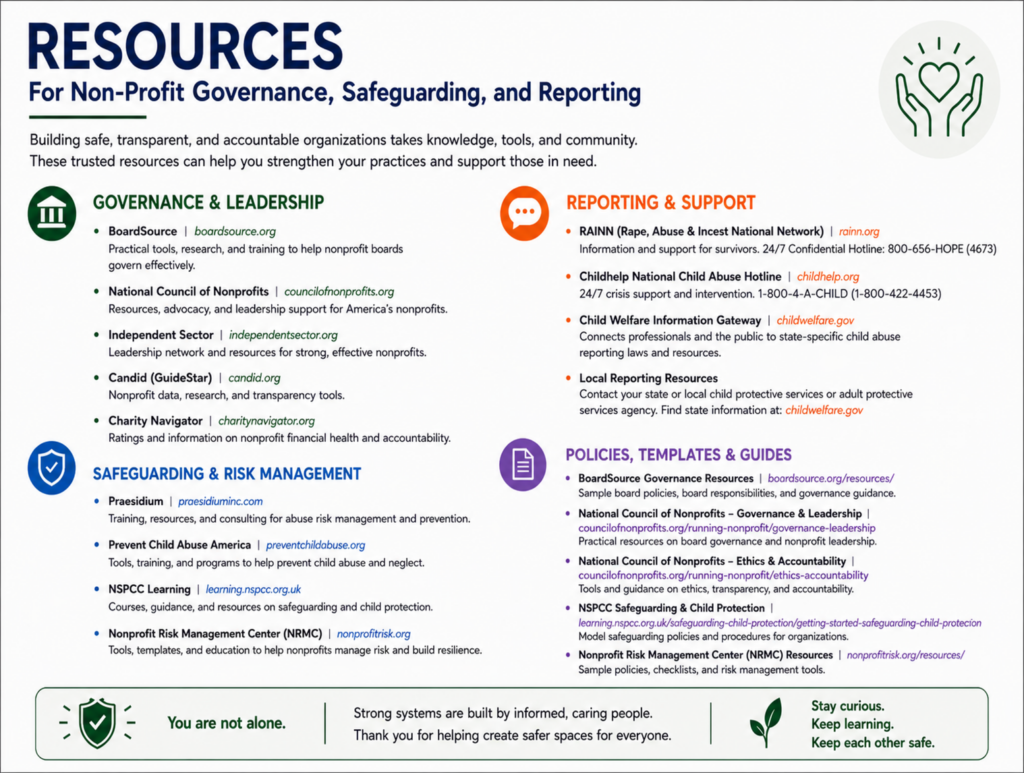
For resources on non-profit governance, safeguarding policies and procedures, and reporting, see the table on p. 5.
Communication and behavior in meetings and presentations
When presenting
- Choose images and terms that are appropriate to your audience.
- Focus on facts, examples, personal experiences and values; avoid terms that promote ideological or other divisions.
- When you express a personal belief, state clearly that it represents your personal perspective.
- Pursue the goal: strengthening people’s desire and resolve to improve life for future generations.
- Come to meetings and presentations prepared.
- Learn what you can about the mission and projects of your audience.
- Review the agenda and accompanying resources.
- Before presenting, review Sustainable Tucson’s position on the topic.
- Sufficiently explain problems but emphasize solutions and their scientific basis.
- Listen and learn, even if you are the main presenter.
When speaking for Sustainable Tucson, stick to officially authorized positions.
Civil discourse
- Address people in respectful, non-judgmental ways.
- Grace and courtesy are timeless values. Avoid demanding, critical, or zealous tones.
- Use tact when commenting publicly on the activities, plans, or programs of other entities (city agencies, non-profits, commissions, etc.).
- Accept people where they are in their journey, rather than judging.
- Keep your mind open to different perspectives.
Whether as leader or participant – in committee, group, project, or activity – focus on instilling trust and inspiring people to cooperate rather than to withdraw or compete. Be sensitive to the potential for types of speech that discourage true discourse and cohesion. Sample game-stoppers to avoid:
- Name-calling
- Labeling
- Not fully attending to what others say
- Hogging the floor
- Repeating yourself
- Arguing
- Nonverbal signs of disdain or contempt (e.g., eye-rolling, heavy sighs)
- Sarcasm
- Haranguing or making unwelcome contact
- Ignoring requests regarding modes or frequency of communication
- Criticizing the work or contributions of others in public or on public forums
- Sexual references and innuendos
Dealing with communication problems
The following notes offer suggestions on approaching the issue when communication is not satisfying. More steps are provided in our formal Complaint Process.
If I feel wronged in an interaction:
When an interaction or relationship feels strained or unsustainable, ask these questions:
- Do I feel unsafe? If so, I need to take action to protect my well-being.
- What are my needs right now?
- What specific behavior feels wrong?
- Have I communicated that?
- What way of handling this situation has a good chance of benefiting us and Sustainable Tucson?
- Do I need help from a colleague to deal with this? If so, how will I arrange that?
If I perceive discomfort in someone I am interacting with:
- Am I treating this person as my equal?
- What is driving me, my agenda, or our friendship?
- Do I understand what they are feeling and why?
- Am I honoring what they have told me in the past? Have I shown them respect and genuine interest in their thoughts, ideas, and feelings?
- Have I abused or made unconscious use of any power my position or status gives me?
- Have I uprooted aspects of my attitude toward them that are based on prejudices or assumptions?
These questions are meant to provide a basis for the kind of internal processing that may be applied to a variety of situations within the scope of Sustainable Tucson activities.
Thanks to Monika Jane Browatzki for input on “Safeguarding Volunteers & Program Participants” and for preparing the resources chart below.
Revised & approved 7/23/26