by Duane Ediger
August 30, 2022
August 2023 update: Cash rebates have become available to nonprofits installing solar since January 2023, with 30% of installed costs covered, and up to 50% for nonprofits that provide low income housing or low-income economic benefits. Learn how your nonprofit can go solar.
In the past two weeks, federal legislation was signed that enables broader participation in the Energy Transformation, and a local renewable project that serendipitously may benefit from it began operation.
The Inflation Reduction Act (IRA) will help lots of folks reduce their carbon emissions, and those benefits are expected to outweigh the bill’s compromises. I will not try here to catalogue all of the IRA’s moving parts, but by focusing on a local project I am involved in, I hope to shine a light on some of the good things the IRA enables.
A pleasant surprise
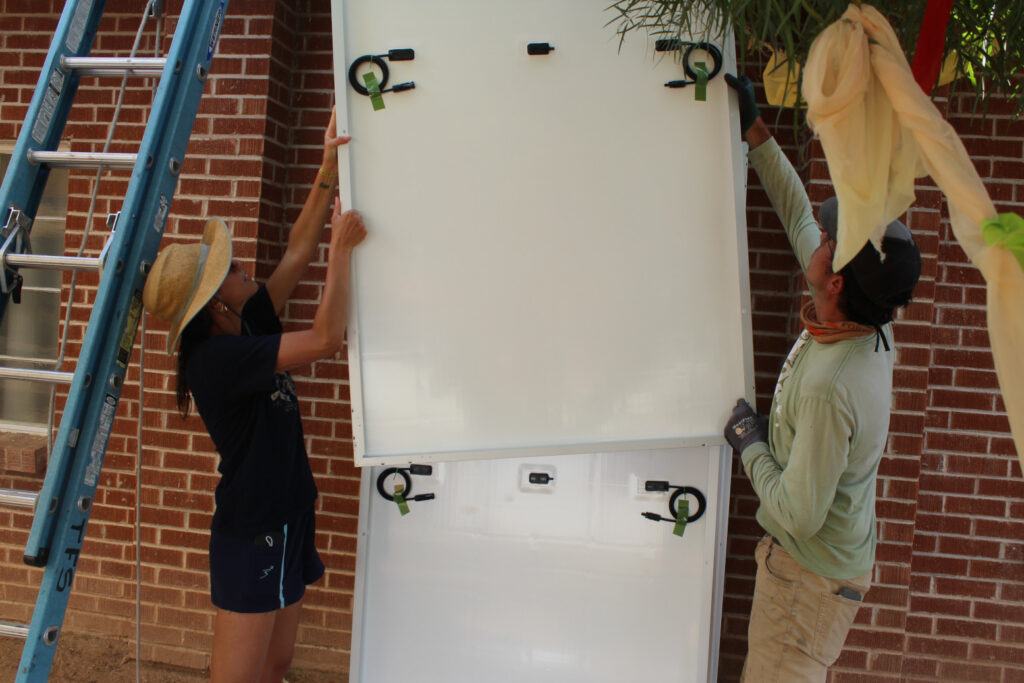
My faith community, Shalom Mennonite Fellowship in southeast Tucson, actively cares for creation, making good use of water, reducing waste and chipping away at our carbon emissions. The last two of four buildings on the church campus to be powered by solar came online August 18, two days after President Biden’s signature entered the IRA into law. The sanctuary and a ministry building next door that used to have separate electric utility connections now share one, and the church’s rooftop solar, coupled with an on-site battery, serve both buildings.
Unlike residential and commercial solar, this nonprofit installation was planned and funded with no expectation of federal support. Only after the electrons began flowing did it become apparent that members of Congress had communities like ours – as well as many others – in mind when they drafted parts of the IRA.
Most residential and commercial solar installations in the United States since 2006 have benefitted from the Investment Tax Credit (ITC), which refunded (until recently) 30% of the cost of most renewable energy installations in the form of a tax credit that offsets federal tax liabilities. The credit in 2022 had fallen to 26%; it was scheduled to drop to 22% in 2023. The IRA restored the 30% credit through 2032 and changed its terms. One change widens the pool of applicable systems by providing a direct payment rather than tax credits. This enables previously ineligible nonprofits to receive the new 30% credit (or whatever it will be called) for systems installed between January 1, 2022 and December 31, 2032. (The Treasury Department will issue guidance for tax-exempt entities that don’t file tax returns to claim the credit.) Just two days after it was turned on, Shalom’s solar became eligible for federal support.
Energy equity for indigenous, low income and “Energy Communities”
In addition to extending the ITC and broadening eligibility to nonprofits, the IRA offers incentives for indigenous nations, low income households and communities and regions suffering impacts from fossil fuel boom and bust cycles, to join the earth-healing renewable energy revolution.
There are of course many other provisions related to EV purchases, EV charging infrastructure, electrification (for example, up to $8,000 toward replacement of gas heating with heat pump), and much more. See Sustainable Tucson’s Toolkit for Energy Transformation for more ideas and support. (It eventually will be updated with the IRA taken into account.)
Many details of administrative application of the new legislation remain to be worked out. The sources linked in this article are intended as aids to further research and are not necessarily vetted for accuracy or reliability.
Duane Ediger is a Board Member of Sustainable Tucson and Chair of its Energy Transformation Working Group.